

Looking Long
Virginia Festival of the Book part 2: Monticello, Laurie Halse Anderson and thoughts on research plus a 250th anniversary prompt

At the recent Virginia Festival for the Book, I had the great good fortune to see Laurie Halse Anderson speak at Monticello about her most recent book, Rebellion, 1776. (Wish they’d recorded this! Watch her interview with JLG here!)
“When we can begin to talk honestly about our country, about our history, about what we did wrong, about what we did right, about what we hope to do better, then we can have some real progress.”
- Laurie Halse Anderson
Most interesting to me, and the whole reason I attended was to hear her talk, was her value of research in reconstructing the world of 1776 for modern readers, which often included old maps, letters, inventories, not yet transcribed by a modern hand. She gave some insight into her process as a writer, one even those of us who are not historic fiction focused share. She had to be guided by her curiosity, going into archives and libraries with an open mind as to what she might find that could indeed destroy the plot lines as she laid them out, or open up a new window to reveal facts of characterization which would bring the story alive for her readers. She didn’t know what she didn’t know.
Her words reminded me that research is a political act. It’s the same process and has the same benefits whether you’ve just learned to read as a child, a scientist looking for traces of a creature thought to be extinct, or are a seasoned archivist hoping to fill in historic gaps. Or if you just want to figure out why your sourdough isn’t starting. Curiosity is an essential human trait, and it’s what helps us grow individually and as a society.
I fear we’ve been “googling” so long that we’ve forgotten that the point of research is the search for truth itself. And not only the freedom to navigate through whatever data is available about your topic, prioritizing it for how true it is, how relevant it is to your search, and — most important in the age we’re living.
The point of research is to think about what you’re researching while you’re doing it — to know better how that reliable source serves to EITHER illustrate your point or help you refine your theory or change your mind. This is not a two step process, like Step 1: Ask the right question. Step 2: Get the right answer. A “conversation” with a chatbot is as much about what the algorithm wants you to hear as it is about what you are hoping to find out. One reason it is programmed to placate with “Good question” and “You’re right!” is so that the information seeker trusts it, not because the questions asked are skillful or it’s just been waiting to tell someone, anyone the facts.
Research is not an end product — “Here is exactly what you want and expect to see.” An important part of research is what we do not know we need, what we can’t predict, and what we encounter as we go along, and how all that that shapes our knowledge about ourselves and what we need. By handing over the reins to Ai we are also limiting our best thinking by cutting it off before it has a chance to grow.
I’ve mentioned before that I have a Masters in Information Science. Long before the internet, librarians were concerned that people’s search behaviors remained private. We as profession know this is not data that should belong to anyone but the person who wanted to find something out. What people look for, how they ask for it, and how often they access it is very telling about who we are. And while it doesn’t tell the whole story, it certainly sometimes tells a story we do not want to share.

Ai hallucinated citations is part of this purposeful (I believe) obscurement, a format they lean into to appear in “research drag.” But the second you click through to validate their sources, you’ll easily find that the information provided often is not accurate, and instead is a delaying of you getting the right information, which only happens if you put in the now extra work of digging every single time you do a search. These “citations” are intended to “look reliable enough” that you don’t double check each one. But the point of citations isn’t just to breadcrumb you back to the truth.
It’s a validation - an assurance that someone, somewhere found source material credible enough to make a published claim of their findings. It serves the dual purpose of holding the original researcher accountable (otherwise we could just make any claim at all!) by giving credit for the hard work it took to take the time to hunt down reliable information, and to prove that someone down the line didn’t just rearrange these ideas and claim they were the first one to think them, thereby profiting from them on the back of unpaid labor and inexpert thievery.
False citations do exactly the opposite. The ai claims to be the truth teller 100% of the time, then some percentage of the time less acceptable than 100%, rearranges ideas and don’t even give you the facts themselves, only "a red herring” to make you think it’s a trustworthy response — stealing the information and claiming it for their own, as well as delivering misinformation.
All these thoughts were spinning around my head on the land that one of our nation’s founders developed. Thomas Jefferson’s own story has been mined, obscured, retold, updated, fact checked. He donated his own library to serve as the seeds for the Library of Congress. His words make up more than 70% of the Declaration of Independence. His quotes line the gift shop, and are brought out every 4th of July.
And yet he had a “relationship” with Sally Hennings, and genetic evidence shows his descendants include her bloodline. The president of the Thomas Jefferson Foundation, which owns and preserves Monticello, formed a special exhibit around her life and work wrote: "We really can't know what the dynamic was. Was it rape? Was there affection?”
Why are we so protective of these leaders, long gone? How can it be consent when one party owns another? Sally Hennings was not freed in Paris, where she had traveled to serve Jefferson, and where she first found out she was pregnant. She wanted to stay there, where she and her baby would be free, since slavery was against the law in France. Jefferson “convinced” her to come home by promising this and all of her future children would be free if she returned with him. That doesn’t sound like love to me. And her children were freed, but she was not. Genetic tests found that all six of her children were fathered by him. After his death that she was permitted to move off the property to nearby Charlottesville.
We can have lots of information and still want more facts, further context, to think through a complicated story. Sometimes the facts don’t free us. That’s not how the saying goes. It’s the truth that sets us free, if we recognize it when we see it.
Wouldn’t you rather find reliable facts, the best that can be found? And if not, if the question is too complicated, wouldn’t you rather be given sources without any misleading preamble or prioritization based on who’s paid to be bumped up in a chatbot search result? How can a chatbot realize a larger truth? Who faces the consequences when it’s wrong? Ultimately it aggregates what it’s been fed, food and bad and spits it back out as factual. We bring our own assumptions along with us, and during research, we can correct those assumptions, and challenge the status quo. Knowing better we can do better. That’s not just on a personal level, but it does start there.
Think of the men who first translated the Odyssey, and the first women to translate it directly from the original Green into English, Emily Wilson, who was the first to notice that the original language indicated that the women who were ordered to be killed weren’t prostitutes as previously translated —and, if they were engaging in sexual acts as slaves, were not always consenting. Her updated translation and further research restores them to their proper place in the story as slaves and rape victims rather than prostitutes. This can shape the way we talk about and think of the victims in the Epstein files.
Questions help rescue victims of many kinds from their very vulnerable and exploited past, and prevents further exploitation in the future. Curiosity and open access to information is everything in a free society.
When I was a librarian, I taught the importance of primary sources to 6th graders, who were excited to dive into images of children just like themselves, of places they thought they knew, but which were suddenly alien and exciting, of events they knew one version of a story, but which suddenly were interesting and multifaceted to them because of the authentic and interest based research they did. *See below for a prompt on the treasure trove of inspiring images available to us at the Library of Congress site!
In 1776, Thomas Jefferson was 33. Alexander Hamilton was only 21. Betsy Ross, 24. The audience was rapt in this talk about liberty because the people who shaped our nation were young, full of hope, aware of the world’s unfairnesses. So is this audience. Keenly aware.
I recently went off on a well known poet on Facebook, after he posted openly saying he was using Ai to “research” his historic fiction. When I tried to slow my outrage, thinking that he perhaps really didn’t know that something seemingly small had a big influence on his creativity, his community and his planet, and responded to other responses saying so — I was further mansplained by one of the original poster’s pals about how good it was to teach ethical uses of Ai, how wonderful it was that Ai could cite sources having summarized something, how I should get with the times. Original poster/famous poet “thanked me for my lecture,” then mocked me, saying I didn’t think Ai had any use at all. Then he kicked me out of the thread.
Did I also start drafting this post in that moment all those weeks ago? Yes.
Did I immediately take the conversation to my own Facebook page? Yes.
Did he care enough to backchannel me at that point, when I said exactly what he first posted, that he was using Ai in his historic fiction writing process? He did.
Did I take it down? Nope.
Did I block him and his defenders in my own page? You bet I did.
I do think Ai has uses. It can make complex mathematic calculations which would literally take humans hundreds of man hours to check and double check, keeping our astronauts safe and getting us to the dark side of the moon. It can spellcheck. It is extremely useful within careful guardrails.
It is intentionally designed to replace the vast majority of the activities that make us human. It is also dangerously capable of robbing us of life, as we learned when OpenAi originally refused to allow the government to remove the guardrails around drones that targeted individuals. Ai endangers our liberty with its monstrously present surveillance state embedding. Never mind the pursuit of happiness, if what a person finds gives them a personal sense of wellbeing and joy is identified by an Ai agent as something to flag.
The question isn’t Is Ai useful? It can and has been used effectively and profitably.
The question is Is Ai harmful?
I think this person’s response to me wasn’t just entitled. On some level, he knew very well I had a point. But he wanted to exclude himself from anyone thinking less of him for using it. So he came at me instead of accepting that his shortcut had a price in some people’s esteem. A consequence.
Laurie Halse Anderson’s Rebellion 1776 is engrossing and delightful, and of course, I was pre-disposed to enjoy her talk about it. But something struck me, as I looked around the audience in that auditorium.
It was packed teens and pre-teens. Lots of young teachers. They knew what it was to live in tumultuous times and to be helpless to the machinations of misogynists who continue to devalue and attempt to strip women and minorities of their rights. If those power continue to devalue women, the men who commit crimes against women can continue to abuse them without being brought to justice.
Men have devalued women for so long they don’t seem to have any connection to the idea of their OWN devaluing by Ai. Of course “not all men.” Forgive me if I overstate, but in recent months, they haven’t voted on behalf of women voting rights, spoken up on behalf of rape victims, protected our reproductive freedoms. The list goes on.
And where were these exceptional men historically — translators, authors, readers — questioning whether or not ALL the slaves wanted to have sex? Why are there still deniers who won’t believe that the same man who fathered Sally Henning’s children was one of our nation’s fathers?
Thomas Jefferson was between 44-46 years old when he impregnated Sally Hennings.
She was 14-16 years old.
Who’s doing the lion’s share of calling for the full release of the Epstein files? I think there’s a clear connection between our nation’s past, Ai chatbots, and what’s still obscured, protected and tacitly accepted today. If you devalue an entire segment of population long enough, and/or make excuses for the problematic behavior that benefits you personally, one day it won’t, and only then will you be able to recognize the maker of your own obsolescence staring you in the face.
While some of these truths are difficult, they’re also necessary. I don’t want to be fed a version of our country’s story that undermines the truth of who we are as a nation.
I’m celebrating the 4th. I hope we can “look long” together, at our past, at our future, and at how we are treating each other in the present. The better we see what’s really there in the mirror, the more we can turn our energies together to our human rights, life, liberty and the pursuit of happiness.
“I’m no AWOL patriot
because I dodged your party lines.
I will always love my troubled nation.
This beautiful land.”
Here’s a little prompt, in thanks for your sticking around through this long post, and in celebration of the 250th.
Prompt: *after “New National Anthem” by Ada Limón
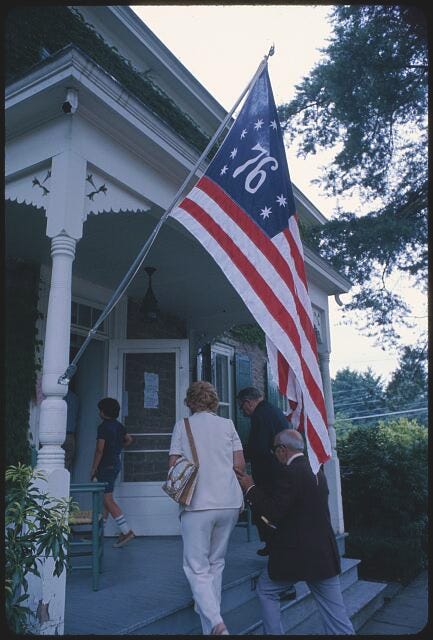
Take a look at the incredible pictures from around the country celebrating the bicentennial in 1976. Gather a few details. What stands out to you as saying something important about freedom? Choose a few that are not national symbols, but personal expressions of that freedom. Were you alive during that time period? If you were, what were you doing/wearing at this time of your life? Do you remember the bicentennial? What might you include as personal symbols of freedoms you enjoy? Write a poem which brings in some of these concrete details, and could serve as an expression of how you feel as we celebrate the 250th.
Hope to write with you soon! <3
Sarah
*After the 4th, we dive right back into Summer at Poet Camp!
Starting Monday…

July 6 – 10 & July 13 – 17, 9:00 – 9:30 a.m. Eastern, Google Meet
Plus more fantastic guest teaching artists:


WHERE MEMORY MEETS MAYBE: Writing Speculative Flash Nonfiction
with Guest Teaching Artist Hannah Grieco
July 12, 3-6 p.m. Eastern, Google Meet
EKPHRASTIC ASSEMBLAGE: Fabricating Poems with the Art of Betye Saar